
by Andrew Olimpi
How do you introduce new vocabulary to your students? Do you have them memorize a list? Discuss a word cloud? Gamify it with Kahoot or Gimkit? Co-create a story?
Heading into the third quarter of my twentieth year teaching, I felt like I was running out of tricks. My old pre-reading activities were starting to feel stale. And I realized why some of my pre-reading, vocabulary-frontloading activities were losing student interest–the activities lacked purpose.
This time of year, I feel stuck between the teacher’s version of Scylla and Charybdis: stale activities on one side, creative burnout on the other. As my usual classroom activities were getting well-worn and ragged, my creativity was beginning to wear ragged too. I needed something easy, low-prep, and engaging.

So I came up with a couple of activities to spice up presenting students with a vocab list. Specifically I designed some activities that gave that mundane task purpose beyond just exposing students to some new Latin words that we would need for the next week’s class.
Activity 1: Vocabula conturbemus! (Vocabulary Scramble)
Instead of projecting this vocab list:
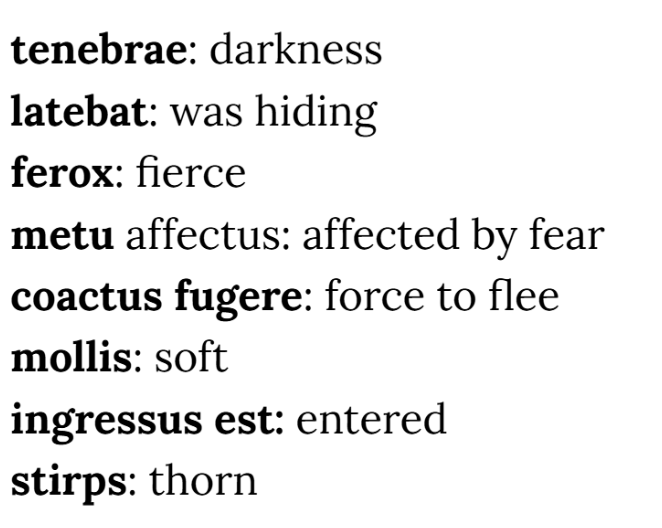
I projected this one:
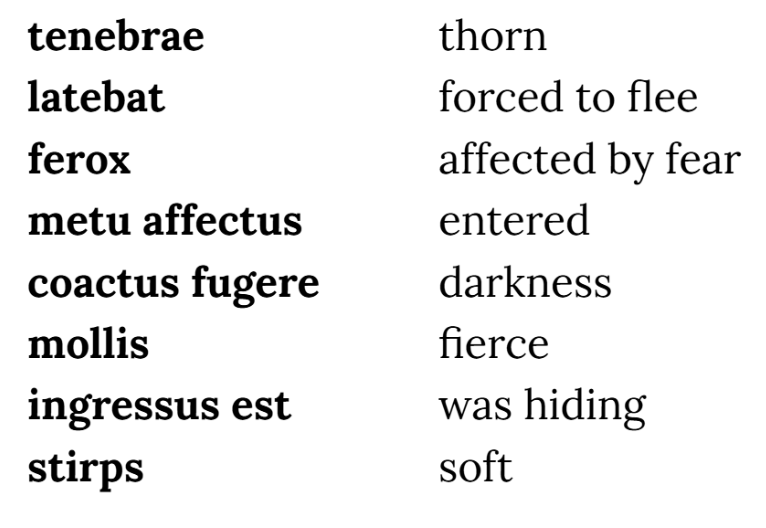
Next I divided students into groups (or they could work alone) and had them match the scrambled Latin and English terms. Afterward, they shared their answers, and we discussed their guesses, including English derivatives.
Nota Bene: For an added twist, you could have the students hear the words first, by presenting the words to them in the form of a dictatio activity. After checking their spelling, the students could then try to match their words to the definitions.
Is this an input-rich, deeply communicative activity? Not really, but my students found it engaging, and I got a mental break from providing input while the students were collaborating. (I did in fact deliver the instructions of this activity in the TL). It did give an inherently purposeless activity some meaning and purpose that created some student interest (and in some classes some healthy competition).
Also, I didn’t stop there. I added a layer of communication with the next activity.
Activity 2: Duae Linguae Stories (Bilingual Stories)
(Note: This is probably a controversial activity that probably deserves its own post. Rather than defending it or presenting my entire rationale, for now I’ll just present the general procedure for the activity).
With partners, or in small groups, students wrote a story. I kept the length of the story very short: four or five sentences max. The rules were simple: this vocabulary list presented vocabulary in the next part of the story we were reading (in this case an adaptation of “Androcles and the Lion” from Gellius’ Noctes Atticae). The students wrote a prediction of what could happen in the story based solely upon the new vocabulary introduced.
The students asked, “Do we write it in Latin or in English?”
I responded: “Both!” (Hence the duae linguae). The students wrote their story in L1, except for the places where they worked in the vocabulary. All vocabulary terms used were written in Latin (I didn’t really have them both about inflections or tenses for this activity). I had the groups afterwards submit typed copies to me via Google Classroom.
A student story would be something like:
Androcles was metu coactus and fell on a mollis stirps. A ferox wolf latebat in the tenebrae of the cave. Et cetera.
(This is my variation of an activity called “One-Word-At-A-Time (OWAT) Stories.” Again, I’ll go into my changes and the rationale behind them in that future blog post.)
The real magic of this activity happened the next day, when I presented the third activity:
Activity 3: “Cloze”-ified Student Stories:
I had several stories by the end of the day, as many as twenty or twenty-five. I picked one or two from each class, typed them up and translated them into Latin (simplifying them along the way).
Then I made copies of the stories with the original vocabulary words that the students inserted blank. So the original story became something like:
Androcles __________ est et cecidit in _____ _______ . Lupus _____ in __________ speluncae __________.
The next day, I took the student stories, translated them into Latin, and removed the vocabulary terms. Students filled in the blanks using a word bank. Afterward, we compared their versions with the originals and discussed their choices.
To extend the activity even further, you could have them do a similar activity with the stories written by the other classes.
And this could be extended even further: You could compare the students vocabulary stories with the original story after you read it, and decide which group made the closest prediction. Or, which student version told the best story.
In the end, a simple vocabulary list sparked multiple meaningful activities—while saving some of my sanity and teaching energy at the same time.
 Comprehensible Classics
Wonderful ♥️
LikeLike
Pingback: Making Pre-Reading Come Alive With “Bilingual Stories” – Comprehensible Classics