
Recently, I’ve been experimenting with a new writing activity in my classes—something I’m calling Duae Linguae stories (or “bilingual” stories).. I first hinted at it in a previous post, assuming it was just a concept I’d picked up somewhere—from a blog, a podcast, or conversation.. But after some digging, I realized that I haven’t come across anything quite like it. That got me thinking: maybe this activity deserves its own official post. After a few months of workshopping and refining, I’ve landed on a procedure that feels just right.
Let me walk you through how it works.
The Product:
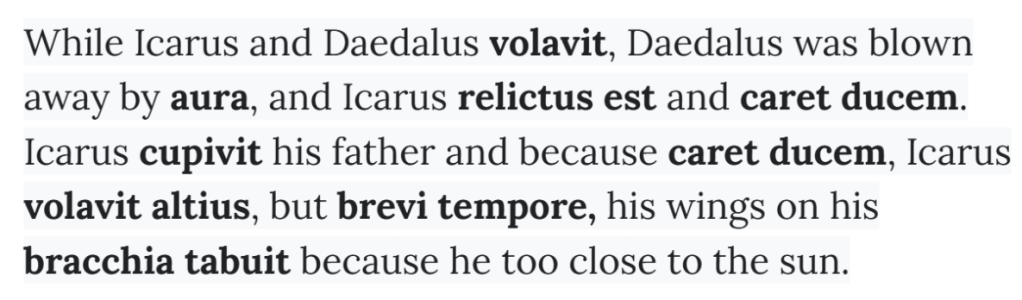
The students create short, bilingual text in the common language (L1) and the Target Language (TL).
Example Student Work:
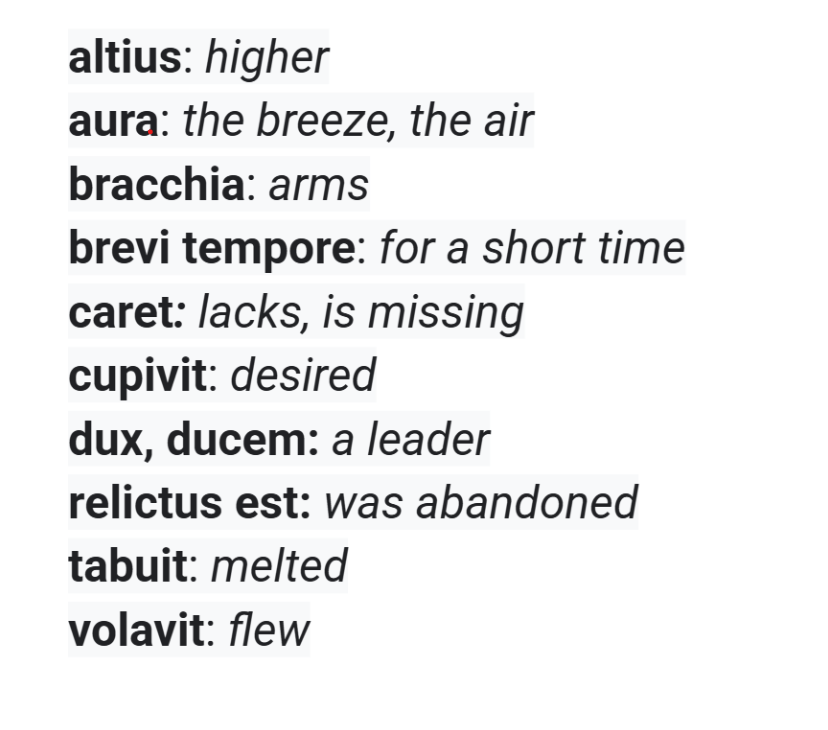
Original Vocabulary List:
The Process:
1. Present the students with a vocabulary list.
2. Give the students a task; for example, predict the plot of the upcoming story using the vocabulary as a clue.
3. Give a strict sentence limit (4 or 5, depending on the length of the vocabulary list)
4. Students complete the task in L1.
5. The twist: Students must use all the vocabulary from the list. So, if the list has twelve words, and the sentence limit is 4, each sentence will use on average 3 vocabulary words.
Step 1: Present a vocabulary list and establish meaning
Your textbook may provide a list, or create one of your own. Perhaps you could consult a word frequency list to help create a list. You could also get creative with a Vocabulary Scramble (link), a Word Cloud (link) discussion, or a dictation.
Step 2: Give the students a purposeful writing prompt
“Purposeful” is the key word for this step.
If the students are beginning a new unit, thematic topic, or story, they could create a prediction of the topic or plot based on the provided vocabulary. Recently, I began a unit about the myth of Daedalus and Icarus. I introduced the three main characters with a short YouTube excerpt, then asked students to predict the plot using their new vocabulary and understanding of the characters.
Of course, they would also just compose any text or story that they wanted in the manner of a One-Word-at-a-Time (OWAT) story.
For an informational text, you would discuss first what students might know about the topic generally, or ask some leading questions to get them thinking about how to use the vocabulary to talk about the subject.
In other words, avoid just having students write random practice sentences or just repeat back known stories. This purpose gives the students a reason to complete the task beyond just simply the act of “covering” some new vocabulary. Purpose shifts the focus from “practicing” the language to communicating with the language fostering language acquisition. Furthermore, from a student’s perspective, assignments with a communicative purpose are just more enjoyable, giving the students a voice and increasing student engagement.
As a starting point, the following are some general prompts that I have used successfully:
– predict the plot of a future story
– predict what happens next in the current story
– create an alternate ending to the current story
– given the list of vocabulary, predict the topic.
– given a historical or cultural context, predict the historical event or cultural practice suggested by the vocabulary.
Step 3: Set a strict sentence limit
I limit student writing to four sentences. This may seem like a strict limit, but my reasoning is:
1.) It’s easier to write using only one new word per sentence. If a vocabulary list is 10-12 items long, that means students will have to use 3-4 words per sentence. This forces the students to think of not just the meaning of the individual words, but how to group words together in ways that make sense in the context they are using them.
2.) Since this is mostly about writing in L1, I want this task to be time efficient.
3.) Shorter texts means less editing and/or translating for me on the backend. Thus, I can use more student texts in extension activities.
4.) The constraints force students to be economical and succinct with their words, encouraging critical thinking as well as creativity.
Step 4: Give students an opportunity to write
Students write the story in L1 individually, with a partner, in a small group. Whichever dynamic you are trying to cultivate. It can also be gamified a bit, the papers could rotating in the style of a rotating OWAT (link). Since writing is in L1, it should be quick. You can have students share and compare their writing. Students could also illustrate their stories after they write them; thus, you end up with student-created stories AND a plethora of student-created pictures to use in an extension activity (Picture Talk, Picture Matching, True or False questions, Partner Marker Game, etc).
I’m always looking for ways for students to read alternate and/or parallel texts, but I can be a bit of a chore to write them myself. What I like about this activity is afterwards I have many student-created parallel texts, all tightly focused on the new vocabulary.
How would you use bilingual stories in your classroom? What parts work best for you? What changes would you make? What extension activities would you use?
Leave a comment below!

